
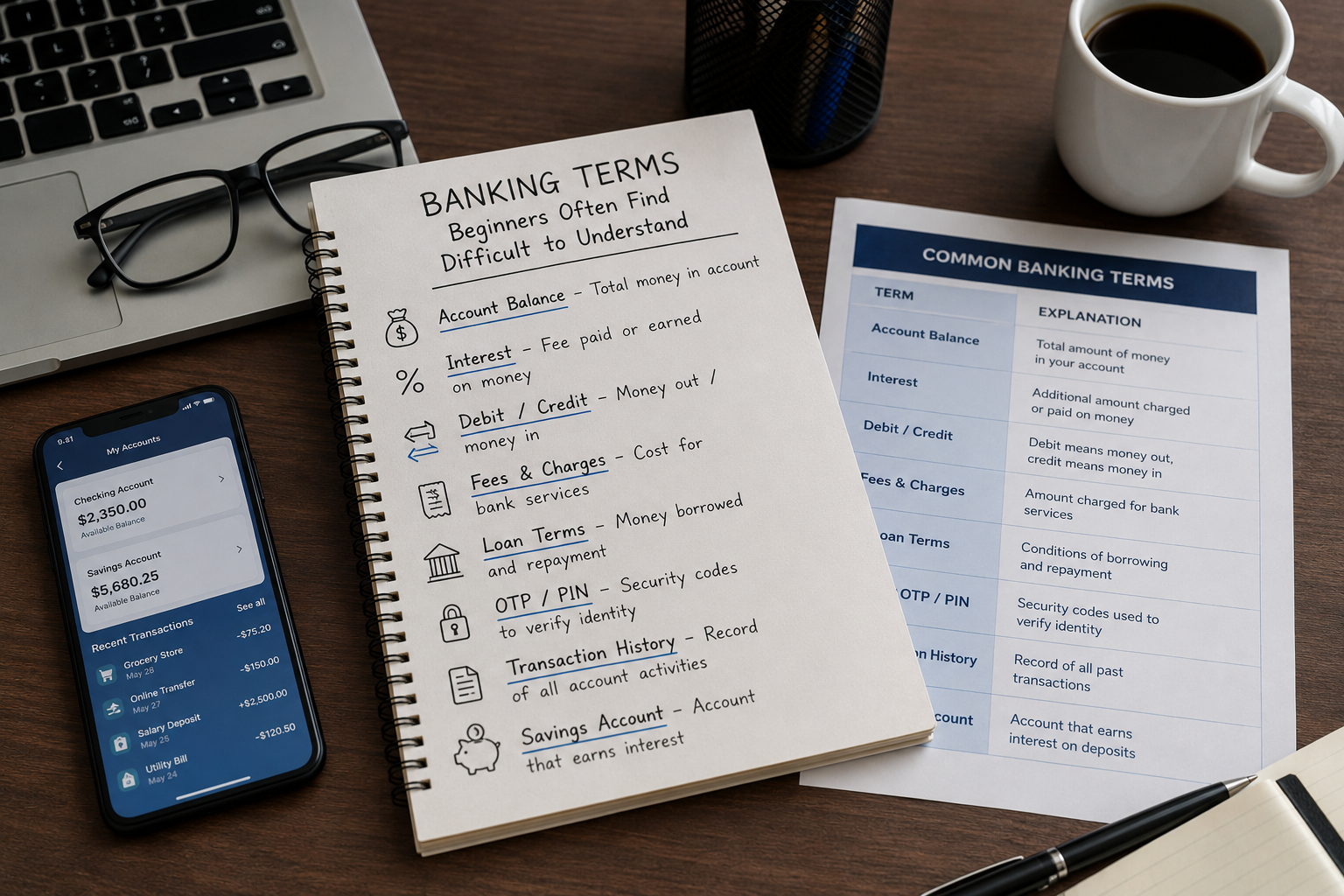
Banking can feel confusing when financial institutions use technical terms that aren’t part of everyday conversation. Whether you’re opening your first account, reviewing your monthly statement, applying for a debit card, or making online payments, you’ll encounter banking terminology that affects how you manage your money. Misunderstanding even a single term can lead to avoidable fees, delayed payments, or poor financial decisions.
The good news is that most banking terms are much easier to understand than they first appear. Once you know what they mean and how they apply to real-life situations, you’ll feel more confident using banking services and making informed financial choices. This guide explains 25 essential banking terms every account holder should know. Rather than offering dictionary-style definitions, you’ll learn what each term means, why it matters, and when you’re most likely to encounter it.
1. Account Balance
Your account balance is the amount of money currently recorded in your bank account. It represents what the bank shows as available in your account at a specific moment. However, many people assume their balance always reflects the money they can spend immediately. That’s not always true. Pending transactions, deposits waiting to clear, or temporary holds can affect the actual amount available.
For example, if your account balance shows $1,000 but you recently made a $150 purchase that is still pending, your available funds may already be reduced even if the balance hasn’t fully updated. Checking your balance regularly helps you avoid accidental overdrafts and gives you a clearer picture of your finances.
2. Available Balance
Available balance is the amount of money you can spend, withdraw, or transfer immediately. Unlike your account balance, this figure considers pending transactions, card authorizations, and any holds placed on your account. Imagine you have:
- Account balance: $2,000
- Pending hotel authorization: $300
Your available balance would likely be around $1,700 until the transaction is finalized or the hold is removed. Many people accidentally overspend because they look only at the account balance instead of the available balance.
3. Checking Account
A checking account is designed for everyday money management. It’s the account most people use for the following:
- Receiving salary payments
- Paying bills
- Using a debit card
- Withdrawing cash
- Sending bank transfers
- Managing monthly expenses
Checking accounts usually prioritize easy access to your money rather than earning high interest. Think of it as your financial hub for daily transactions.
4. Savings Account
A savings account is intended for storing money you don’t need to spend every day. Unlike checking accounts, savings accounts often pay interest on your balance, helping your money grow gradually over time. People commonly use savings accounts for goals such as the following:
- Emergency funds
- Vacation savings
- Home repairs
- Education expenses
- Future large purchases
Although you can usually withdraw money when needed, savings accounts are better suited for building financial security rather than everyday spending.
5. Interest
Interest is the money earned or paid based on an account balance or loan amount. When your savings account earns interest, the bank pays you for keeping your money deposited. For example, if your savings account earns 3% annual interest, your balance gradually increases without additional deposits. Interest also works in the opposite direction when borrowing money. Loans, mortgages, and credit cards typically require borrowers to pay interest to the lender. Understanding how interest works helps you compare financial products more effectively.
6. Overdraft
An overdraft occurs when you spend more money than is available in your account. Depending on your bank’s policies, several things might happen:
- The payment is declined.
- The bank temporarily covers the payment.
- An overdraft fee is charged.
- Your account becomes negative until funds are deposited.
For example, if you have $40 available but use your debit card for a $60 purchase, your account may enter an overdraft if the transaction is approved. Regularly monitoring your available balance is one of the simplest ways to avoid overdrafts.
7. Routing Number
A routing number is a unique code that identifies a financial institution. It helps ensure money is sent to the correct bank during transactions such as
- Direct deposits
- Electronic transfers
- Bill payments
- Payroll processing
- Government benefit payments
Think of the routing number as the bank’s address within the financial system. Without the correct routing number, payments may be delayed or sent to the wrong institution.
8. Account Number
Your account number uniquely identifies your personal bank account within your financial institution. Even if thousands of customers use the same bank, each account has its own unique number. This number is commonly required when:
- Setting up direct deposits
- Receiving transfers
- Linking payment apps
- Scheduling automatic bill payments
- Connecting financial services
Because your account number is sensitive financial information, it should only be shared when necessary and with trusted organizations.
9. Direct Deposit
Direct deposit is an electronic payment sent directly into your bank account. Instead of receiving a paper check, employers and organizations transfer funds electronically. Common examples include:
- Salary payments
- Government benefits
- Tax refunds
- Pension payments
- Insurance reimbursements
Many people prefer direct deposit because it is faster, reduces the risk of lost checks, and often makes funds available sooner.
10. Direct Debit
Direct debit allows a company or service provider to collect money directly from your bank account after you have given permission. It’s commonly used for recurring payments such as
- Utility bills
- Internet services
- Mobile phone plans
- Streaming subscriptions
- Insurance premiums
- Loan repayments
For example, if your electricity bill is due on the 15th of every month, the provider can automatically withdraw the payment without requiring you to make the transfer manually. While direct debit offers convenience, it’s still important to review your account regularly. Subscription prices, billing errors, or forgotten services can result in unexpected withdrawals if you’re not monitoring your transactions.
11. Pending Transaction
A pending transaction is a payment that has been authorized but hasn’t yet been fully processed by the bank. You’ll often notice pending transactions after:
- Shopping online
- Paying at restaurants
- Booking hotels
- Buying fuel at a gas station
- Using your debit card in stores
During this period, the transaction usually reduces your available balance, even though it hasn’t officially posted to your account. For instance, you buy groceries for $85. The amount immediately appears as pending. A day or two later, it changes to a completed transaction. This delay is normal and allows the merchant and bank to finalize the payment.
12. Statement
A bank statement is a detailed record of all activity in your account during a specific period, usually one month. A statement typically includes:
- Deposits
- Withdrawals
- Debit card purchases
- Bank transfers
- Fees
- Interest earned
- Opening and closing balances
Reviewing your statement regularly helps you:
- Spot unauthorized transactions.
- Track your spending habits.
- Verify automatic payments.
- Catch billing mistakes before they become larger problems.
Even if you use a banking app every day, monthly statements provide a complete financial record that’s useful for budgeting and tax purposes.
13. Debit Card
A debit card allows you to spend money directly from your bank account. Unlike a credit card, you’re using your own available funds rather than borrowing money. Debit cards can be used for:
- In-store purchases
- Online shopping
- ATM withdrawals
- Contactless payments
- Mobile wallet payments
Because purchases are tied directly to your account, keeping track of your available balance is especially important when using a debit card regularly.
14. ATM
An Automated Teller Machine (ATM) lets you perform basic banking tasks without visiting a bank branch. Most ATMs allow you to:
- Withdraw cash
- Check your balance
- Deposit money (at supported machines)
- Transfer funds
- Change your PIN in some cases
While ATMs offer convenience, some machines—especially those operated by another bank—may charge additional fees. Before completing a transaction, it’s worth checking whether any charges apply.
15. PIN (Personal Identification Number)
A PIN is a confidential numeric code used to verify your identity when accessing your account or using your debit card. You’ll commonly enter your PIN when:
- Withdrawing cash
- Paying in stores
- Using certain self-service banking machines
A strong PIN should be difficult for others to guess. Avoid combinations like the following:
- 1234
- 0000
- Your birth year
- Consecutive numbers
Never write your PIN on your debit card or share it with anyone, even someone claiming to represent your bank.
16. Wire Transfer
A wire transfer is a secure method of sending money electronically between bank accounts. Wire transfers are often used for:
- Large purchases
- International payments
- Property transactions
- Business payments
- Urgent transfers
Unlike some everyday payment methods, wire transfers are often processed individually and may involve transfer fees. Because many wire transfers are difficult or impossible to reverse once completed, always double-check the recipient’s banking details before sending money.
17. Electronic Funds Transfer (EFT)
Electronic Funds Transfer, often shortened to EFT, refers to the electronic movement of money between bank accounts without using cash or paper checks. Examples include:
- Direct deposits
- Online banking transfers
- Bill payments
- ATM withdrawals
- Debit card purchases
- Automatic recurring payments
Most people use EFTs every week without realizing it. They have become one of the most common ways to move money quickly and securely.
18. Bank Transfer
A bank transfer is the process of moving money from one account to another. Transfers may occur:
- Between your own accounts
- To another person
- To a business
- Between different financial institutions
For example, you might transfer part of your paycheck from your checking account into your savings account every month. Many people automate this process to make saving more consistent. Before confirming a transfer, always verify the recipient’s account details. Correcting an error after funds have been sent can be difficult.
19. Minimum Balance
Some bank accounts require customers to maintain a minimum balance. If your balance falls below this amount, the bank may:
- Charge a maintenance fee.
- Reduce certain account benefits.
- Change the account type under specific conditions.
Not every account has this requirement, which is why it’s important to understand the terms before opening a new account. If you prefer keeping only small amounts in your account, consider choosing an account that doesn’t require a minimum balance.
20. Monthly Maintenance Fee
A monthly maintenance fee is a recurring charge some banks apply for keeping an account open. Whether you pay this fee depends on your account type and the bank’s policies. In some cases, the fee may be waived if you:
- Maintain a minimum balance.
- Receive regular direct deposits.
- Meet certain transaction requirements.
- Hold multiple eligible accounts.
Many account holders overlook these small monthly charges because they happen automatically. Reviewing your statement every month can help you determine whether you’re paying fees that could be avoided by switching account types or meeting the bank’s eligibility requirements.
21. Bank Reconciliation
Bank reconciliation is the process of comparing your personal financial records with your bank statement to ensure everything matches. While businesses perform bank reconciliations regularly, individuals can benefit from doing the same. It helps you:
- Identify missing transactions
- Catch duplicate charges
- Spot unauthorized activity
- Correct budgeting errors
- Verify deposits and withdrawals
For example, if your budgeting app shows a payment that doesn’t appear on your bank statement, reconciliation helps determine whether the transaction is still pending or was recorded incorrectly. Making reconciliation a monthly habit improves financial accuracy and helps prevent small mistakes from becoming larger issues.
22. Standing Order
A standing order is an automatic payment instruction that you set up through your bank to send a fixed amount of money at regular intervals. People often use standing orders for:
- Rent payments
- Savings contributions
- Family support
- Loan repayments
- Membership fees
Unlike a direct debit, where the recipient requests the payment amount, you remain in control of the amount and payment schedule. If your rent is $900 every month, you can create a standing order that automatically transfers exactly $900 on the same date each month.
23. Transaction History
Your transaction history is a chronological record of all activity in your account. It typically includes:
- Purchases
- Cash withdrawals
- Deposits
- Transfers
- Fees
- Interest payments
- Refunds
Regularly reviewing your transaction history helps you understand your spending patterns and detect unusual account activity quickly. Many banking apps allow you to search, filter, or categorize transactions, making it easier to monitor recurring expenses and prepare a monthly budget.
24. NSF (Non-Sufficient Funds)
NSF stands for Non-Sufficient Funds, meaning your account doesn’t contain enough money to complete a payment. If an automatic payment or check is presented when your balance is too low, the transaction may be rejected. Possible consequences include the following:
- Returned payment fees
- Late payment charges from the merchant
- Service interruptions
- Damage to your payment history with certain providers
For example, if a $75 subscription payment is due but your account contains only $40, the payment may fail because of insufficient funds. Checking upcoming automatic payments before they are due can help prevent these situations.
25. Beneficiary
A beneficiary is the person or organization receiving money during a bank transfer. Whenever you send money electronically, you’ll usually need to provide details about the beneficiary, such as:
- Name
- Account number
- Bank information
- Routing or transfer details where applicable
Entering incorrect beneficiary information can delay a payment or send funds to the wrong account. Before confirming any transfer, take a few moments to review all recipient details carefully. A simple typing mistake can sometimes be difficult to correct after the payment has been processed.
A Quick Reference Table for Common Banking Terms
| Banking Term | What It Means | Why It Matters |
|---|---|---|
| Account Balance | Total money shown in your account | Helps you monitor overall funds |
| Available Balance | Money you can currently spend | Prevents overspending |
| Checking Account | Account for daily transactions | Used for bills, purchases, and salary deposits |
| Savings Account | Account for storing money | Supports long-term financial goals |
| Overdraft | Spending beyond available funds | May result in fees or declined payments |
| Pending Transaction | Payment awaiting completion | Explains temporary balance differences |
| Direct Deposit | Electronic payment into your account | Faster and more secure than paper checks |
| Direct Debit | Authorized automatic withdrawal | Simplifies recurring bill payments |
| Standing Order | Automatic fixed payment you control | Useful for rent, savings, and regular transfers |
| NSF | Not enough money to complete a payment | Can lead to failed transactions and fees |
Practical Tips for Understanding Banking Terms
Learning banking terminology isn’t just about expanding your financial vocabulary—it helps you make smarter decisions with your money.
Here are a few habits that can improve your confidence:
- Check both your account balance and available balance before making large purchases.
- Read your monthly bank statement instead of relying only on your mobile banking app.
- Review automatic payments every few months to make sure they’re still needed.
- Keep your contact information updated with your bank so you’re notified of unusual account activity.
- Take a moment to read unfamiliar banking terms before agreeing to new financial products or services.
- Save copies of important account documents and statements for future reference.
These simple habits can reduce mistakes and help you stay in control of your finances.
Common Mistakes People Make
Even experienced account holders occasionally misunderstand banking terminology. Here are some of the most common mistakes:
- Assuming the account balance is always the same as the available balance.
- Ignoring pending transactions before making another purchase.
- Forgetting about automatic payments linked to old subscriptions.
- Overlooking monthly maintenance fees that could potentially be avoided.
- Sending money without carefully checking beneficiary details.
- Rarely reviewing transaction history or monthly statements.
- Confusing standing orders with direct debits, even though they work differently.
Recognizing these mistakes early can help you avoid unnecessary fees and payment problems.
Conclusion
Banking doesn’t have to be complicated. Many of the terms that seem technical at first are simply labels for processes you’ll encounter throughout your financial life. Once you understand what they mean and how they apply to everyday banking, you’ll find it easier to manage your accounts, avoid common mistakes, and make informed financial decisions.
Keep this guide as a reference whenever you come across unfamiliar banking language. The more comfortable you become with these terms, the more confident you’ll feel when using banking services, comparing financial products, or planning your financial future.
FAQs
1. Is an available balance always lower than my account balance?
Not always. If there are no pending transactions or temporary holds, both balances may be identical. Differences usually appear when recent payments or deposits are still being processed.
2. Can pending transactions disappear?
Yes. If a merchant cancels a transaction or an authorization expires before the payment is completed, the pending transaction may disappear, and the funds become available again.
3. What’s the difference between a standing order and a direct debit?
With a standing order, you decide the payment amount and schedule. With a direct debit, you’ve authorized a company to collect payments, and the amount may vary depending on your bill.
4. Why should I review my bank statement if I already use a banking app?
A monthly statement provides a complete record of your account activity and can make it easier to identify errors, recurring charges, or suspicious transactions.
5. Are all bank accounts charged monthly maintenance fees?
No. Some accounts have no monthly fees, while others waive them if certain requirements—such as maintaining a minimum balance or receiving regular direct deposits—are met.
