
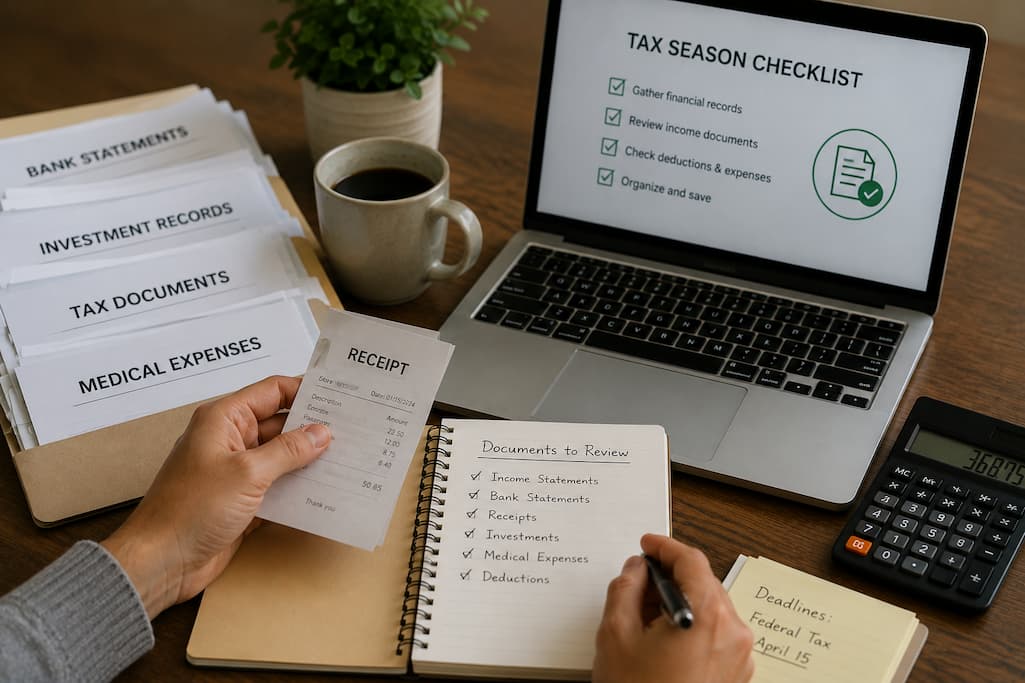
For many, the most dreaded part of the tax filing period is not the tax itself, but the difficulty in finding crucial financial documents. Finding a few important documents—such as bank statements, income statements, or receipts—can turn what should be a simple tax return into a frustrating ordeal. As the tax filing deadline approaches, finding documents becomes increasingly difficult.
A pre-tax filing financial check is more than just gathering documents. It allows you to carefully verify that everything is complete and correct before you start filing your tax return or providing information to a tax advisor. To correct errors, obtain missing information, and get everything organized—and thus avoid unnecessary stress—it is advisable to check your documents as early as possible.
Consider It a Personal Financial Checkup
Many people view filing a tax return as a one-time event. But in reality, checking your financial documents in advance makes filing much easier. Checking your records can answer several important questions:
- Are all your receipts consistent?
- Is every expense listed on your bank statements?
- Have you kept documents regarding major purchases or deductible expenses?
- Do I need to verify if any financial documents are missing?
To avoid last-minute problems, it is best to gather the answers before you start filing your tax return.
Gather Everything Before Reviewing Anything
It is a common but incorrect habit to go through documents as you go along. Crucial problems can arise later, and you will eventually have to look up the information again. Gathering all necessary documents should be your first step. Here are some examples of what you might bring:
| Financial Record | Why It Matters |
|---|---|
| Income statements | Verify earnings received during the tax year |
| Bank statements | Confirm deposits and payments |
| Investment records | Review investment-related activity |
| Tax forms received from employers or financial institutions | Support tax reporting |
| Business income and expense records | Organize self-employment information |
| Donation receipts | Document eligible charitable contributions where applicable |
| Major purchase records | Support records that may be relevant for taxes or future reference |
Having everything together provides a complete picture of your finances and reduces the likelihood of overlooking important information.
Check for Missing Documents
Wait a little while before you start filing your records after you’ve gathered them. Rather, evaluate your current situation in light of your expectations. Could it be that you’re anticipating the following?
- Every year, a bank statement.
- A brief overview of investors.
- Original proof of income from a prior job.
- Information gathered from independent contractor jobs.
- Interest statements from financial accounts.
Making a note of any missing documents early on will allow you plenty of time to get replacements if needed. There may be less time to fix missing documentation if you wait until the filing deadlines are coming up.
Verify Data Instead of Assuming It Is True
Errors can sometimes be found in even official documents. It is beneficial to review them thoroughly. It is better to compare data from different records than to depend on just one. For instance, you should check that your bank statements and your records of job or business are generally in agreement on the money that has been deposited. Thoroughly examine significant transactions to ensure comprehension, and double-check that your records accurately reflect significant financial occurrences that transpired throughout the year. The point is not to look for errors that are unlikely to exist. Before you use your records for taxes, you should double-check that they fairly represent your financial activities.
Create Categorized Files
When you organize papers in a sensible way rather than haphazardly stacking them, tax preparation becomes considerably simpler. A complex filing system is unnecessary. In most cases, simple classifications will suffice. Just to illustrate:
- Earnings from employment.
- Revenue generated by a company.
- Financial documents.
- Investment information.
- Paperwork pertaining to real estate.
- Documents pertaining to insurance.
- Gifts to charitable organizations.
- Tax communication.
- Returns from prior years.
If you group similar entries together, you will find information later more easily and are less likely to forget something crucial.
Compare and Contrast Paper and Digital Records
Numerous households today maintain various repositories of their financial data. You may get some papers through email. Some households access them through internet banking. Some documents are still sent via regular mail. It is possible to save paper receipts and electronic invoices in different places. Reviewing just one format leaves gaps where none should be. See your digital and paper records as interdependent components of a single financial system. To ensure that your records are comprehensive, it is recommended that you review both your electronic bills and paper receipts for significant purchases.
Pay Attention to Life Changes During the Year
After a significant life event, you may find that the amount of paperwork associated with taxes increases. Check to see if you have the paperwork that goes along with any major changes that happened this year. Some examples are:
- Taking a beginning or ending position.
- Taking the plunge into self-employment or a freelance job.
- Property acquisition and sale.
- Wedlock or separation.
- Changing residences.
- Starting a family.
- Getting a bequest.
- Disposing of assets.
During your evaluation, be sure to include the supplementary paperwork that events like these typically create.
Most People Don’t Give Receipts the Attention They Deserve
Not every receipt is worth your time, but some are. Your specific situation and the tax regulations in your area will determine the significance of receipts relating to business dealings, charity contributions, large purchases, and other transactions that may affect your tax liability. Arrange your receipts according to category or month instead than letting them jumble in envelopes or all over your email folders. When examining records later on, even a basic folder organization can save a lot of time. Be sure to name your digital receipts clearly so you can find them without opening each file individually.
Review Before You File—Not After
Many individuals are only thinking about this year’s taxes. Reviewing the return from the prior year can help you better remember regular financial activity. It might, for instance, serve as a yearly reminder to find records of your investments, income, or any other papers that you get. There is no duplication of data. To make sure you haven’t overlooked anything crucial, you can simply refer to earlier records.
Avoid Relying on Memories by Making a Checklist
Dealing with various financial documents makes memory less dependable. It is far more effective to have a documented checklist. Things that could be part of it are:
- Received income documentation.
- Financial records examined.
- Asset records compiled.
- Income for the business organized.
- I have the expense records.
- Filed receipts for donations.
- Get your hands on the return from last year.
- I am requesting the missing documentation.
You can be sure that nothing has been forgotten when you cross things off the list as you finish them.
Be Sure to Read Before Submitting—Not After
It is much more annoying to discover a mistake after the fact than it is to discover one before submitting. It is important to thoroughly study your records before submitting your return, so make sure to set aside enough time for that.
Make sure your financial records are consistent and that you have read and verified all of the necessary paperwork. In many cases, minor, easily fixable flaws are uncovered during a thorough assessment before they escalate into major administrative headaches. An additional hour spent getting everything ready can save you a lot of time later.
Avoiding Common Errors
Rather than complex tax regulations, many issues that arise during tax season are the result of simple organizational habits. Among the most typical blunders are the following:
- Planning to get financial documents in order before the filing date.
- Avoiding changes to access by failing to download electronic statements in advance.
- Presuming that all paperwork has been sent.
- The practice of combining individual and company funds.
- Depending totally on recollection instead of employing a checklist.
- Choosing to disregard minor differences in financial records.
- Getting rid of evidence too soon.
Preparing your taxes will go much more smoothly if you avoid these behaviors.
Conclusion
Starting to prepare for tax season well in advance of when you actually need to fill out forms can make the process much more manageable. By doing a thorough review of your financial records as soon as possible, you may fix minor problems, find missing documents, and arrange information more precisely.
Instead of seeing tax preparation as a mad dash to find missing information, you should approach it as an organized procedure based on a thorough understanding of your financial records. Tax season doesn’t have to be a stressful ordeal if you stick to a simple filing system, make use of a practical checklist, and keep records regularly throughout the year. Having your finances in order is the first step in doing effective tax preparation, and the work you put in before tax season usually returns dividends even before you file your return.
FAQs
1. When is the best time to start going over my financial records?
You should begin organizing your documents, finding missing records, and requesting replacements if needed at least a few weeks before you want to prepare your taxes.
2. Do I need to examine paper documents in addition to digital ones?
Reviewing them simultaneously is usually the best option. If you want your records to be comprehensive, you should combine the two formats since many people receive financial information in both.
3. What should I do in the event that I find documents that are mysteriously absent?
If you need to get new records before you file, it’s best to get in touch with your employer, bank, or other relevant financial institution as soon as possible.
4. How come I should review my tax return from last year?
You can find recurrent documents and financial activity that may be relevant to this year’s filings in your previous reports.
5. After I file, do I have to retain any copies?
If you want to be prepared for any questions that may come up or if you need to refer to them for any reason related to money, it’s a good idea to keep organized copies of your tax return and any financial records that support it.
