
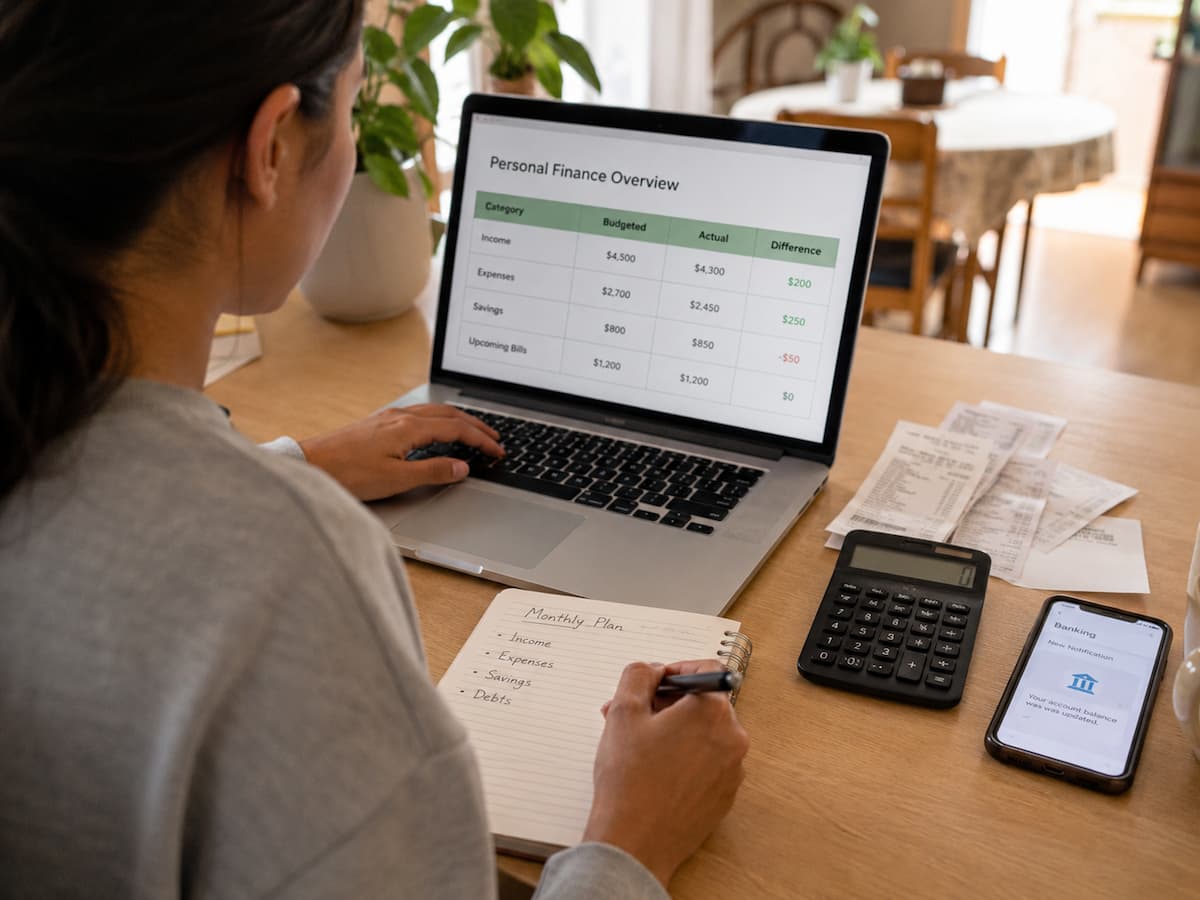
Personal finance tracking and analysis systems solve this problem by consolidating important information into a structured process. No complicated calculations or advanced spreadsheet functions are required. A simple system can help you record income, track expenses, check bills, analyze your savings, and detect unusual transactions. More importantly, it gives you the ability to make small adjustments regularly to prevent financial problems from escalating. This guide teaches you how to create a practical, daily, and easy-to-maintain system.
Determine What you Really Need to Track
The first mistake people often make is trying to record everything. A good financial system should provide relevant information and not turn it into a full-time job. But first: before you choose an app or create a spreadsheet, determine what you really want to know.
For most households, basic information includes income, daily bills, daily expenses, savings, debts, and important financial deadlines. You may also need to track a number of easily overlooked annual expenses, such as insurance premiums, membership fees, tuition, or car expenses. View your system as a dashboard, not a locker. The goal is to help you make decisions. If what you track doesn’t influence your behavior, you should probably remove it from your system.
Choose a Fixed Location for Your Data
Your data should be kept in a fixed place. That could be a spreadsheet, a budgeting tool, a journal, or whatever you find convenient. The most advanced method is usually not the best choice, but rather the method you are most likely to continue using. Spreadsheets are a good option for users who value flexibility. You can create various categories, such as income, expenses, recurring bills, savings, and year-end expenses. If you prefer automatic categorization of transactions, a budgeting app might be more suitable. For households that simply want a basic overview of their finances without complex calculations, a notebook will suffice.
No matter which method you choose, avoid using multiple conflicting systems at the same time. Tracking your expenses in both a notebook and an app will eventually reveal which version of the data is accurate. Choose the simplest method that provides a reliable picture of your finances. A simple method that you use daily is more valuable than a complex method that you abandon after just two weeks.
Build your Financial Overview
You do not need dozens of categories for an effective personal financial overview. Start with five basic categories: income, expenses, fixed costs, savings, and debts. These categories give you a clear overview without having to analyze every small transaction.
Income. Record your salary, income from self-employment, business income, or other fixed sources of income. For expenses, you can organize group expenses into appropriate categories, such as groceries, transport, housing, utilities, entertainment, and personal expenses. Fixed costs are the costs you expect to incur every month. In the savings section, you can see how much you save and how each savings goal is used. If you have debts, record the balance, the amount owed, the interest (if applicable), and the maturity date.
| Area | What to Record | Why It Helps |
|---|---|---|
| Income | Salary and other regular income | Shows available money |
| Spending | Everyday purchases by category | Reveals spending patterns |
| Fixed commitments | Rent, bills, subscriptions | Helps prepare for predictable costs |
| Savings | Contributions and goals | Tracks progress over time |
| Debt | Balances and required payments | Makes obligations visible |
Record Transactions Without Making It Complicated
Once you have a basic structure, consider how frequently you are going to update it. Some want to record their purchases right away while some like to check their transactions once or twice a week. Either way is OK. If you bank online, you may be able to check your transaction history and update your records in batches. This will save you time, but you should still confirm your transactions have been classified accurately. Automatic categorization is not always right.
For example, a grocery purchase may include groceries, household supplies, and personal items. If that degree of detail is not relevant to you, not everything has to be separated. The aim is to develop categories that help you understand your habits. Keep the number of categories low enough so tracking a simple transaction isn’t frustrating. Twenty perplexing categories are typically not as helpful as five useful ones.
Maintain a Separate List of Recurring Payments
Recurring expenses can go unnoticed for months, so it’s important to keep an eye on them. Make a separate list for the recurring payments you make, such as rent or mortgage payments, utilities, subscriptions, insurance, memberships, and other commitments.
Note the approximate amount, payment date, and frequency for each recurring payment. If the amount varies regularly, write that too. This gives you a view of your finances going forward, not just recording what has already happened. Look at this list every few months. You might find you’re paying for a service you hardly use or a subscription has increased in price. The effect of eliminating a needless recurrent cost is more profound over time than trying to consistently eliminate minor one-off purchases.
Utilize a Calendar to Track Financial Deadlines
Financial records tell you what happened, but a calendar lets you plan for what’s next. Add key payment dates and annual financial events to the calendar you already regularly check. This could be insurance renewals, annual subscriptions, tax deadlines, school payments, loan installments, or other major obligations. Depending on the necessity of the payment, you can schedule reminders days or weeks ahead.
This is especially handy for those expenses that happen once or twice a year. They are easy to miss, because they don’t appear on your monthly calendar. If an annual spend is predictable, you might want to spread the estimated cost over the year in your planning system. You don’t need a separate bank account for every expense, but knowing a significant payment is due can be useful so you’re not caught out.
Do a Monthly Review that Takes Less than an Hour
This is the review that makes your records into usable information. But if you don’t regularly go over it, a financial record is just a lot of numbers. Set a designated day each month to go over your accounts. First, make sure that the income you have reported is correct. Next, check how your actual expenses stack up against what you intended to spend. Don’t try to find every little difference; look for areas that changed a lot.
Next, look at bills coming up, savings progress, and debt payments. Ask yourself some practical questions: Was there anything unusual? Are any of the bills going up? Did I overspend in one area more than I normally do? Got a payment you no longer need? Do I have to change the plan for next month? It’s not to beat yourself up about it. It is to see patterns while there is still time to act.
Search for Trends Rather Than Judging Individual Purchases
It’s more instructive to look at the trends across several months when you do a financial analysis. One pricey supermarket trip may signify nothing. “But if it’s been rising steadily for six months, that’s something to look into. That goes for subscriptions, travel, eating out, internet shopping, and other flexible expenses. Search for changes that reoccur. Look at recent months.
You may also see favorable trends. Perhaps your debt load is steadily decreasing or you are now contributing more consistently to your savings. Recording progress will allow you to see changes that are hard to see from month to month. Search for patterns that require you to make a decision. Your financial records should help you understand what’s changing, not make you feel terrible about every purchase.
Protect Your Financial Documents
Your financial records could have sensitive information, and security should be considered from the outset of the system. If you utilize a digital file, safeguard your device with a strong password or screen saver. Update your operating system and financial programs. Be cautious about saving full account numbers, passwords, or other information that could create undue risk if someone revealed the file. Usually, your financial record does not need to contain your banking login credentials.
If you use cloud storage, turn on multi-factor authentication on the account. Where appropriate, keep backup copies, but avoid making unnecessary copies of sensitive information on multiple devices. Paper records must also be kept safe. When you no longer require documents holding sensitive information, shred them instead of just chucking them in the household waste.
Remember Non-Regular Expenses
One of the most typical mistakes in personal financial tracking is that people tend to focus primarily on monthly expenses. Real life has expenditures, and they’re not on a monthly basis; they just pop up here and there. Examples include changing a phone, fixing a car, renewing insurance, buying gifts, paying annual fees, or unforeseen home bills. These costs can make a monthly budget look deceptively manageable until the bill arrives.
Create a category in your financial records for yearly expenses. Predict higher expenses, and estimate when and approximately how much. The numbers do not have to be precise. The goal is to make these expenditures evident ahead of time.
Facilitate the System to Continue
The finest financial record system is the one you can stick with when life becomes hectic. If you are going to spend several hours a week going over your accounts, it may be too complicated. Automate as much as possible. If they match your situation, arrange for transaction alerts, pay your bills automatically when possible, and set up regular transfers to savings. Automation decreases the number of decisions you need to make yourself.
But don’t automate everything and forget about it at the same time. Things change; thus, a monthly evaluation is still worth doing. Income can go up or down, bills might rise, subscriptions can become obsolete, and priorities can vary.
The Easy Monthly Review Process
If you have any doubts, follow the same routine every month. First, check your account balances and confirm your revenue. Please verify transactions and correct any errors in your books. Then review any recurring payments and impending due dates.
Then, analyze progress on savings and debt. Look back to the earlier months and assess your spending. Pick one or two areas that need some work. Finally, make a little change for next month if necessary. It doesn’t have to be an ideal financial plan that the process creates. Its worth is in its repetition. A simple monthly assessment can detect problems earlier than an annual financial check-up.
Conclusion
Setting up a personal financial record and review system is not difficult and doesn’t require expensive software or advanced financial understanding. The aim is just to build a dependable way to visualize your money plainly. Get the fundamentals right: record income, control spending, mark recurring bills, manage savings and debt, and remember major expenses that are not monthly.
Once you have the system in place, check it on a regular basis. This monthly snapshot will help you see changing spending trends, prepare for impending bills, and recognize financial success. As time goes on, these little reviews can help us go from reacting to money decisions to being more intentional about them.
Most crucial, make a structure that works for your real life. If it is easy enough to use often, it can become a useful habit of daily life. You don’t have to have immaculate records. You need a good enough picture of where your money is going to be able to make better judgments with the information you have.
FAQs
1. How often do I need to update my financial records?
There’s no one schedule that’s right for everyone. Some people like to record transactions every day; others check them once or twice a week. The main thing is consistency.” A weekly assessment is frequently a good practical starting point, as it stops transactions building up but also avoids the effort of recording every purchase straight away.
2. Do I need a fancy spreadsheet?
No. A simple spreadsheet with columns for income, expenditure, bills, savings, and debt can be all that you need. The system is there to assist you in understanding your finances, not to create additional administrative labor. Use a simple framework; elaborate only where it is informative.
3. Should I log every little purchase?
If little purchases account for a significant percentage of your spending, tracking them can assist. But you don’t need to capture every detail if it makes your system hard to manage. Use categories to help you recognize patterns. The right detail is the level that offers you helpful insight without making financial tracking feel like work.
4. What happens if you spend more than you planned?
First, find out why it happened instead of trying to cut everything right away. Was the rise due to a one-time expense, an increase in prices, a new recurrent payment, or a change in your habits? Once you know the reason for it, consider whether you need a short-term adjustment or a long-term change.
5. Do I need to keep past transactions?
Keeping historical records can allow you to see long-term trends and may be valuable for some financial or tax-related purposes. But that doesn’t mean you have to hold on to every detail all the time. Keep critical financial records for the duration required by applicable laws and regulations, and securely destroy sensitive records that you no longer need.
6. What is the most significant portion of a financial review?
The most important thing is to work out what you need to do in response to the changes. Look at income, spending, debts due, savings, and debt, but pay attention to anything that has changed a lot. A thorough evaluation will provide you a better picture of what’s going on and what, if anything, you need to do next.
