
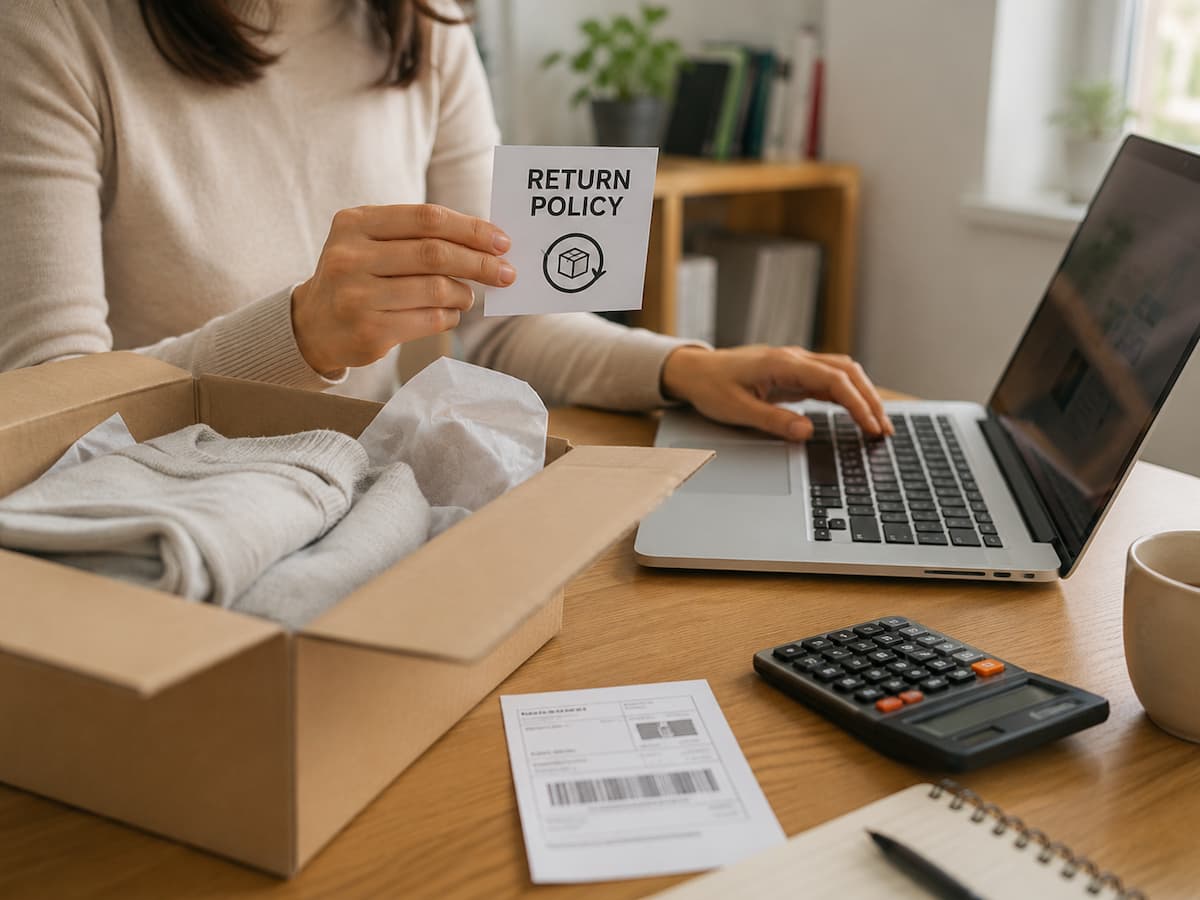
A product can look affordable until something goes wrong with the purchase. Imagine buying a jacket online for $80. It arrives, but the fit is wrong. At first, returning it seems simple: send it back and get your money back. Then you discover that the retailer does not provide a prepaid return label. Shipping the package back costs $9. The original shipping charge is also nonrefundable. Suddenly, trying the jacket has cost far more than expected, even though you no longer own it.
This is why the price shown on a product page is not always the full economic cost of buying that product. Return policies can affect how much money a customer ultimately spends, how much financial risk they take when trying an unfamiliar product, and whether a low-priced item is actually a better deal than a similar item sold elsewhere. A generous return policy may reduce the cost of making the wrong choice, while a restrictive policy can make a purchase pricier if the item needs to be returned, exchanged, or replaced. Understanding these policies before buying does not mean reading every line of legal text. It means knowing which parts of the policy can change what the purchase really costs.
The Purchase Price Is Only the Starting Point
When people compare products, they usually focus on the listed price. That makes sense because it is the most visible number. But the real cost of a purchase can depend on what happens after the transaction. A useful way to consider the total cost is this:
Real cost = product price + unavoidable purchase costs + costs incurred if the product must be returned or exchanged.
The last part is often ignored because nobody expects to need it. Yet uncertainty is part of many purchases. Clothing may not fit. Electronics may not work as expected with existing equipment. Furniture may look different in a room than it did online. A gift may be duplicated. Even a perfectly functioning product can turn out to be unsuitable.
Suppose two stores sell the same item. Store A charges $95 and offers free returns. Store B charges $85 but requires the customer to pay return shipping and deducts a handling fee from the refund. Store B initially appears cheaper. However, if there is a meaningful chance that the item will need to be returned, the lower sticker price does not tell the whole story. The better deal depends partly on the likelihood of keeping the item. This does not mean a generous return policy automatically makes a higher-priced product worth buying. If you are highly confident about the purchase, a cheaper option with stricter return terms may still cost less. The important point is that return flexibility has value, particularly when there is uncertainty.
Return Shipping Can Turn a Refund Into a Partial Loss
One of the most direct ways a return policy affects cost is through return shipping. Some retailers provide prepaid return labels. Others require customers to arrange and pay for shipping themselves. In some cases, a retailer may offer a prepaid label but deduct its cost from the final refund. These arrangements can produce very different outcomes.
Consider a $40 product that must be returned because it is unsuitable. If the retailer provides a genuinely free return, the customer may recover the full eligible refund. If returning the product costs $8, however, the unsuccessful purchase has effectively cost $8, assuming the product itself is fully refunded. For low-priced items, return shipping can be especially significant. Paying $10 to return a $25 product may not make economic sense. A customer may decide to keep an unwanted item simply because returning it would recover too little money.
There is also a practical difference between free returns and free shipping for returns. A policy may sound generous in marketing language while still containing conditions. The customer may need to use a particular shipping method, return the item within a specific period, or pay a deduction if they choose another option. Before purchasing an item that may be difficult to choose without seeing it in person, it is worth checking exactly who pays for the journey back.
Restocking and Handling Fees Can Reduce the Refund
Some return policies allow the retailer to deduct a restocking, handling, or similar fee from the refund under certain conditions. The effect is straightforward: receiving a refund does not necessarily mean receiving all of the money originally paid.
For example, a customer might purchase an item for $300 and later discover that returning it triggers a 10 percent restocking fee. Should the policy apply to that purchase, the customer could still lose $30 even if the return is accepted. Any separate shipping costs or nonrefundable charges could increase the total loss further. These fees are particularly important for products that involve a high chance of reconsideration. Large items, specialty equipment, custom-configured products, and purchases made without seeing the item in person may carry more uncertainty than everyday items bought locally.
The key issue is not simply whether a fee exists. Customers should also understand when it applies. A policy may treat an unopened item differently from an opened one. A fee may apply when the customer changes their mind but not when the retailer sent the wrong item. The rules may also differ depending on whether the product is defective, damaged, incorrectly described, or simply unwanted. Those distinctions can determine whether a return costs nothing or becomes an expensive mistake.
The Length of the Return Window Has Financial Value
A 30-day return window is not automatically better than a 14-day window for every customer, but time can matter. Short return periods increase the risk of missing the deadline. This is especially relevant when a product is purchased as a gift, ordered well before it will be used, or requires time to test properly.
Imagine ordering a device that you will not use until several weeks later. By the time the buyer discovers that it does not meet their needs, the standard return period may already have expired. A longer window gives the buyer more flexibility to inspect, test, compare, and decide. That flexibility can reduce the chance of being stuck with an unsuitable product.
However, the advertised number of days is only one part of the policy. Customers should check when the clock starts. Some retailers count from the purchase date, while others may base the period on delivery or another defined event. The exact rule can materially affect how much time is actually available. It is also worth checking whether the retailer requires the item to arrive back before the deadline or only requires the customer to start the return process within that period. A generous-looking return window can be less useful if the practical requirements are difficult to meet.
A Store Credit Is Not the Same as Getting Your Money Back
Another detail that can affect the real cost of a purchase is the form of the refund. A return may result in money being returned to the original payment method, but some situations may instead lead to store credit, an exchange, or another restricted form of compensation. These outcomes have different value. A $100 refund gives the customer the freedom to spend that money elsewhere. A $100 store credit keeps the money tied to the same retailer.
Store credit may still be useful if the customer regularly shops with that business and plans to buy something else. But it has less flexibility than cash or a refund to the original payment method. The customer may end up making another purchase simply to use the credit. This can change the economics of the original transaction. A customer who intended to spend $100 once may effectively become committed to spending that value within a particular store.
The same issue can arise with exchange-only policies. If the product was purchased because it seemed like the best option but turns out to be unsuitable, an exchange may force the customer to choose a second-best product rather than recover the money and shop elsewhere. For this reason, the phrase “returns accepted” does not provide enough information on its own. It matters what the customer actually receives after the return.
Final Sale and Excluded Items Carry More Purchase Risk
Some products cannot be returned under ordinary conditions, even when the retailer has a general return policy. Final-sale products are an obvious example, but exclusions can also apply to clearance items, personalized goods, opened products, perishable products, downloadable items, or other categories depending on the retailer and applicable rules. The financial implication is simple: when an item cannot be returned for ordinary reasons, the buyer takes on more of the risk.
A discounted product may therefore not be the better value if the discount is small but the inability to return it creates significant uncertainty. Suppose a regular version of a product costs $100 and can be returned, while a final-sale version costs $90. Saving $10 may look attractive. But if there is a reasonable possibility that the item will not work, fit, or meet expectations, the customer is accepting more risk to save that $10. The correct decision depends on the situation. A final-sale item can be an excellent purchase when the buyer knows exactly what they are getting. It becomes more questionable when the purchase involves uncertainty. The discount should be considered alongside the loss of flexibility.
Exchanges Can Also Create Hidden Costs
An exchange policy may sound like a convenient alternative to returning an item, but it is worth checking how the process works. If the replacement item is sent immediately and the retailer covers the relevant shipping costs, an exchange may be simple. In other cases, the customer may need to return the original item at their expense before ordering again. Price differences can also matter. An exchange for another size may be straightforward, but switching to a different product could require paying more or may be handled as an entirely new transaction.
There is also a less obvious cost: time. A complicated exchange process can leave the customer without the product for an extended period. This may not matter for a casual purchase, but it can matter when you need the item for work, travel, or another time-sensitive purpose. The financial cost of an exchange is therefore not always limited to a visible fee. Additional shipping, price differences, and the inconvenience of repeating the buying process can all affect the overall value of the purchase.
Comparing Return Policies Can Change Which Product Is Actually Cheaper
When two products are similar, comparing their return policies can help identify the better value. A simple comparison might look like this:
| Factor | Lower-Priced Option | Higher-Priced Option |
|---|---|---|
| Product price | $80 | $90 |
| Return shipping | Customer pays | Free |
| Restocking fee | Possible | None |
| Return window | 14 days | 30 days |
| Refund type | Store credit in some cases | Original payment method |
The $80 option may be the better choice if the buyer is certain about the product. But the $90 option provides more protection if something goes wrong. This does not mean customers need to calculate the exact probability of every possible outcome. A practical approach is to consider the level of uncertainty.
If you already own the same product in another size, the risk may be low. If you are buying from an unfamiliar brand, choosing between several sizes, or purchasing an expensive item based only on photos, the return policy becomes more important. The greater the uncertainty, the more valuable flexibility usually becomes.
What to Check Before Completing a Purchase
A quick review of a few details can help you avoid problems later. Check these parts of the return policy before buying, as the return terms could influence your decision:
- How many days do you have to request or complete a return?
- Who pays for return shipping?
- Is any prepaid label truly free, or is its cost deducted from the refund?
- Are original shipping charges refundable?
- Are there restocking or handling fees?
- Will you receive a refund, store credit, or only an exchange?
- Does the product need to be unopened or in original condition?
- Are certain products marked as final sale or excluded from returns?
- Are defective or incorrect items handled differently from ordinary returns?
You do not need to investigate every inexpensive purchase in this much detail. The policy deserves more attention when the item is expensive, difficult to evaluate online, unusually large, from an unfamiliar seller, or unlikely to be useful if it turns out to be wrong. A few minutes spent checking the terms can provide information that is more useful than comparing product prices alone.
The Return Policy Is Part of the Product Decision
A return policy is often treated as something to think about after a problem occurs. In reality, it can be part of the purchasing decision itself. The listed price tells you what it costs to acquire the item. The return policy helps determine what it could cost if the purchase does not work out. That distinction becomes more important as uncertainty increases. Free or low-cost returns, reasonable time limits, and clear refund rules can reduce the financial downside of making the wrong choice. Strict deadlines, expensive return shipping, restocking fees, and store-credit-only policies can have the opposite effect.
The goal is not to avoid retailers with restrictive policies or assume that every purchase will need to be returned. It is to compare the price with the conditions attached to the purchase.
Before clicking the buy button, ask one useful question: If this product turns out to be wrong for me, what will it cost to undo the purchase?
The answer may change which option is actually the better deal.
FAQs
1. Does a return policy really affect the price of a product?
It can affect the real cost of the purchase if you need to return or exchange the item. Return shipping charges, restocking fees, nonrefundable delivery costs, and reduced refund amounts can leave you with an out-of-pocket expense even after returning the product.
2. Is free shipping the same as free returns?
No. Free shipping usually refers to delivering the product to you. “Free returns” refers to the cost of sending the product back. A retailer may offer one without offering the other.
3. Is store credit as valuable as a refund?
Not necessarily. Store credit has the same face value but can only be used with the retailer that issued it. A refund to the original payment method generally gives the customer more flexibility.
4. Should I avoid final-sale products?
Not always. A final-sale product can offer good value when you are confident about the purchase. The lack of return flexibility matters more when there is uncertainty about fit, quality, compatibility, or suitability.
