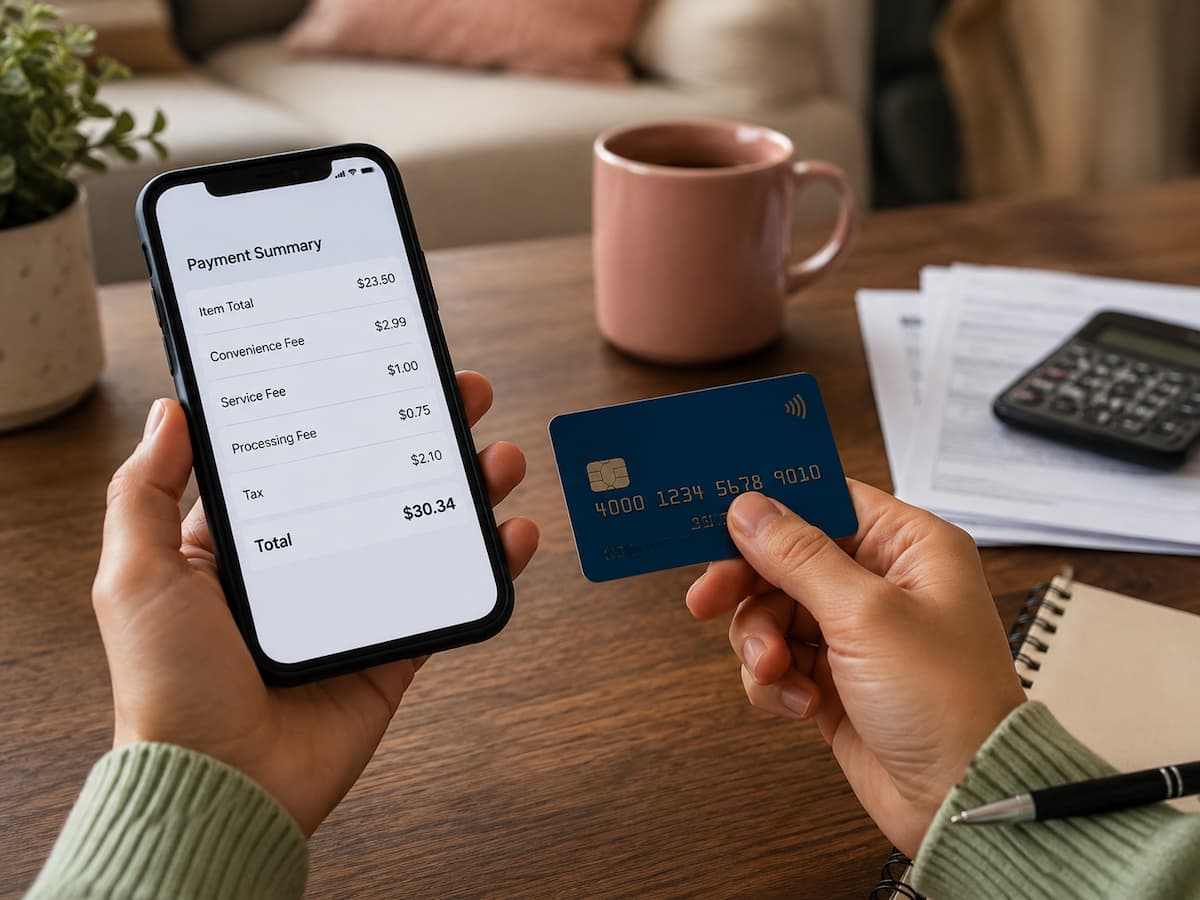
A convenience fee rarely feels expensive on its own. It might be $1.50 for ordering food through an app, $2 for paying a bill online, or a few extra dollars for buying tickets through a digital platform. The purchase still goes through. The main price still looks reasonable. Most people move on without giving the fee much thought. The problem becomes clearer when those small charges repeat.
Convenience fees can quietly increase everyday spending because they often attach to purchases people already intended to make. Instead of deciding to spend an extra amount, the customer sees the fee only after choosing the product or service. At that point, the additional charge may feel too small to reconsider. This article takes a different approach from simply listing types of fees. Instead, it follows the journey of an everyday purchase—from the first displayed price to the final amount paid—and shows where convenience charges can change spending decisions.
The Price You Notice Is Often Not the Price You Pay
Consider a simple purchase. You see a service advertised for $20. That is the number that attracts your attention and helps you decide whether the purchase seems affordable. Then the checkout process begins.
Step 1: The Base Price
The original $20 creates your expectation of cost. At this stage, you are comparing the purchase with alternatives based mainly on the advertised price.
Step 2: The Extras Appear
As you continue, additional charges may appear:
- A convenience fee
- A service fee
- A platform fee
- A processing fee
- A delivery-related charge
- A payment-related charge
Now the final cost may be $24 instead of $20. The difference may not seem large enough to cancel the purchase. But the important change has already happened: the buying decision was made using one number, while the payment is completed using another.
Step 3: The Higher Price Becomes Normal
If this process happens repeatedly, customers can gradually become accustomed to paying extra charges. A $3 fee may feel insignificant when attached to a $60 purchase. It may feel even less important when the purchase is something you make regularly. Over time, however, the total amount spent on convenience can become much larger than any single transaction suggests.
Why Small Fees Are So Easy to Ignore
Convenience fees often benefit from comparison. When a $2 fee appears next to a $50 purchase, people naturally focus on the larger amount. The fee looks small relative to the total. This scenario is different from being asked to spend $2 on its own.
If someone asked, “Would you like to pay me $2 for almost nothing?” the decision might receive more thought. But when the same $2 appears as a small line during checkout, it can feel like a minor part of an already completed decision. Several factors can make these charges easier to overlook.
The Main Purchase Feels More Important
People tend to focus on the product, service, or problem they are trying to solve. Someone ordering dinner may care more about getting food delivered quickly than about analyzing each small charge. Someone buying event tickets may focus on securing a seat before availability changes. The convenience fee becomes secondary because the main purchase has already captured attention.
The Fee Appears Late in the Process
Once buyers have spent time selecting products, entering information, and reaching the payment stage, many buying decisions become harder to reverse. At that point, a small extra charge may not seem worth abandoning the entire transaction. This does not mean customers are unaware of the fee. They may simply decide that restarting the process or searching for an alternative requires more effort than the small amount seems to justify.
Repetition Makes the Charge Feel Ordinary
The first time you notice a fee, it may stand out. After seeing similar charges repeatedly, it can start to feel like a normal part of purchasing. That normalization is important because an expense does not need to be large to affect a budget. It only needs to happen often enough.
The Real Cost of Convenience Is Usually Repetition
A single convenience fee is easy to dismiss. The more useful question is how often the fee occurs. Imagine paying an average of $3 in extra convenience-related charges three times each week. That would be:
- $9 per week
- Around $36 over four weeks
- More than $400 over a year if the pattern continued consistently
The exact total will vary because people do not spend the same amount every week. The purpose of the example is not to predict anyone’s expenses. It shows why small charges deserve attention when they repeat. The same pattern can appear across different parts of daily life. You might pay one fee for food delivery, another for buying tickets online, another for a faster payment method, and another for using a particular service platform.
Because the charges come from different businesses, they may never appear together in your mind as one category of spending. This fragmentation can make it hard to notice the total. A useful budgeting habit is to stop viewing convenience fees as isolated events and instead view them as a recurring spending category.
Where Everyday Convenience Fees Can Appear
Convenience charges can appear in many ordinary transactions. The names may differ, but the basic idea is similar: the customer pays an additional amount connected to the way a purchase or service is accessed.
1. Food and Delivery Orders
Delivery platforms may add charges beyond the menu price. Depending on the service and order, the final amount may include delivery-related fees, service charges, small-order charges, or other applicable costs. This means comparing menu prices alone may not tell you what the order will actually cost. A $15 meal can become a much more expensive purchase once the full checkout amount is calculated.
2. Event and Ticket Purchases
Tickets may be advertised at one price while additional charges appear during the booking process. A convenience or service fee can cause the total for two tickets, which initially seem affordable, to exceed the budget once the final total is displayed. The important number is the full amount required to complete the purchase, not only the price shown at the beginning.
3. Digital Payments and Transactions
Some payment methods or platforms may involve additional processing or transaction charges. The cost may be small, but it can matter when you use the same payment method frequently. Before treating a payment option as automatically convenient, it can be useful to compare the extra charge with the amount of time or effort it actually saves.
4. On-Demand Services
Fast access often comes at a premium. A customer may pay more to receive an item sooner, access a service immediately, avoid visiting a physical location, or use an intermediary platform. Sometimes the extra cost is completely reasonable. The problem appears when the convenience is purchased automatically rather than deliberately.
Convenience Can Be Worth Paying For
The goal is to accept some convenience fees. Convenience has real value. It may be a sensible decision to pay an extra amount to save significant time, avoid a difficult trip, meet an urgent deadline, or access something that would otherwise be unavailable.
The better question is
What am I receiving in exchange for this extra charge?
A convenience fee may be worthwhile when
- The purchase is urgent.
- The alternative requires significantly more time or effort.
- The fee is small compared with the value of the time saved.
- There is no practical lower-cost alternative.
- You understand the total cost before completing the purchase.
The same fee may be poor value when it is paid only out of habit. For example, paying extra for rapid delivery may make sense when you urgently need an item. Paying for the same service every time, even when there is no time pressure, can turn an occasional convenience into a permanent spending pattern. The difference is intentional spending.
A Quick Test Before You Pay
You do not need to investigate every small fee. A simple decision process can help when convenience charges appear frequently.
Ask: Can I see the final total?
Do not evaluate the purchase using only the advertised price. Before paying, look for the complete amount. This includes the product or service price plus any relevant charges required to complete the transaction.
Ask: Is There a Lower-Cost Way to Do the Same Thing?
The alternative does not need to be completely free. Perhaps ordering directly costs less than using an intermediary. Maybe choosing a different delivery option reduces the fee. Perhaps waiting one extra day avoids an express charge. The point is simply to know that an alternative exists before you pay for convenience.
Ask: Would I Pay This Fee If It Were a Separate Purchase?
This question can make a small charge easier to evaluate. If the convenience fee were presented independently, would you still consider the benefit worth paying for? Occasionally the answer will be yes. That is useful information. Other times, seeing the charge separately makes it clear that you are paying for something you do not particularly value.
Ask: How Often Do I Pay Similar Fees?
This is where small charges can become more significant. A $2 fee paid once may not deserve much attention. A $2 fee paid dozens of times is a different kind of expense. Frequency can matter more than the size of any individual charge.
The Hidden Problem: Convenience Fees Can Change Your Buying Habits
Convenience charges do not only increase the cost of purchases. They can also make certain purchasing habits easier to repeat. If ordering something takes only a few minutes, the barrier to spending becomes lower. The additional fee may not stop the purchase because the entire process is designed to feel quick and simple. Over time, convenience can replace activities that once required more deliberate decisions.
Walking into a store requires planning. Preparing food at home requires planning. Comparing several sellers requires time. Convenience services reduce those barriers, which can be useful. But reduced effort can also mean reduced reflection before spending. The fee is therefore only one part of the financial effect.
The larger issue may be that paying for convenience makes certain purchases easier to repeat without much consideration. This is why tracking only the fees themselves may not provide a complete picture. It can also be useful to examine the behavior connected to those fees.
A Simple Example: The $5 Difference
Imagine two ways to make the same purchase.
Option A:
Buy directly for $30.
Option B:
Use a convenient platform for $35 after additional charges.
The difference is $5. If the platform saves you a significant amount of time or solves a real problem, the extra $5 may be worthwhile. Now imagine making the same choice four times per week.
The additional cost becomes:
- $20 per week
- Roughly $80 over four weeks
- More than $1,000 over a year if the pattern remained consistent
Again, this is only an illustration. Real spending patterns vary. But the example shows why convenience decisions should sometimes be evaluated as habits rather than isolated purchases.
The question changes from “Is $5 a lot?” to “What does paying $5 repeatedly add up to?”
That is often a more useful way to understand everyday spending.
How to Reduce Unnecessary Convenience Costs Without Making Life Difficult
Trying to eliminate every extra charge can become inconvenient in its own way. The more practical goal is to identify the fees that provide little value.
1. Group Similar Purchases Together
Instead of making several separate orders, consider whether combining purchases could reduce repeated transaction or delivery-related charges. This will not always be possible, and larger purchases should not be made simply to reach a fee threshold. The purpose is to avoid paying multiple small charges for purchases that could reasonably be planned together.
2. Use Convenience Selectively
Save premium delivery, expedited access, and paid intermediaries for situations where they genuinely solve a problem. Using them occasionally can be very different from making them the default option.
3. Check the Total Before Confirming
A purchase that starts at one price may end at another. Making a habit of checking the final total can prevent small fees from becoming invisible.
4. Review Repeated Charges
Look back at recent transactions and identify fees that appear regularly. You may discover that the issue is not one expensive charge but several small charges connected to the same habit. Once the pattern becomes visible, it is easier to decide which conveniences are worth keeping.
The Goal Is Awareness, Not Perfection
Convenience fees are not automatically wasteful. Sometimes paying more is the rational choice. Time has value, urgent situations exist, and a convenient option can genuinely make life easier. The problem begins when the extra cost is never considered because it feels too small to matter.
Everyday spending is often shaped by repeated decisions rather than dramatic purchases. A few dollars added to one transaction may disappear into the background. The same few dollars, paid repeatedly across months, can become a meaningful part of total spending.
The most useful habit is simply to notice the full price. Before paying a convenience fee, pause long enough to ask what it is buying you. When the answer is clear and the benefit justifies the cost, paying the fee may be perfectly reasonable. If you cannot explain why the convenience is worth the extra money, that small charge may be a sign that the purchase deserves a second look.
FAQs
1. What is a convenience fee?
A convenience fee is an additional charge associated with using a particular method, platform, service, or purchasing option. The exact meaning and rules can vary depending on the business, payment method, and location.
2. Are convenience fees the same as hidden fees?
Not necessarily. A fee may be clearly disclosed before payment and still increase the final cost. A charge is easier to evaluate when the customer can see it clearly before completing the transaction.
3. Why do small convenience fees matter?
Small fees can matter when they occur frequently. Looking at a single charge may make the cost seem insignificant, while reviewing repeated charges over weeks or months can reveal a larger spending pattern.
4. Should I always choose the cheapest option?
No. The cheapest option is not always the best choice. Paying extra for convenience can be worthwhile when it saves meaningful time, solves an urgent problem, or provides a benefit you genuinely value.