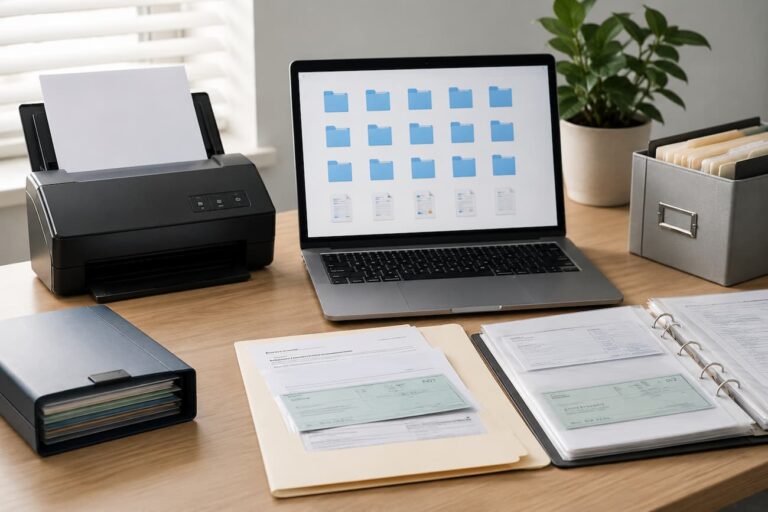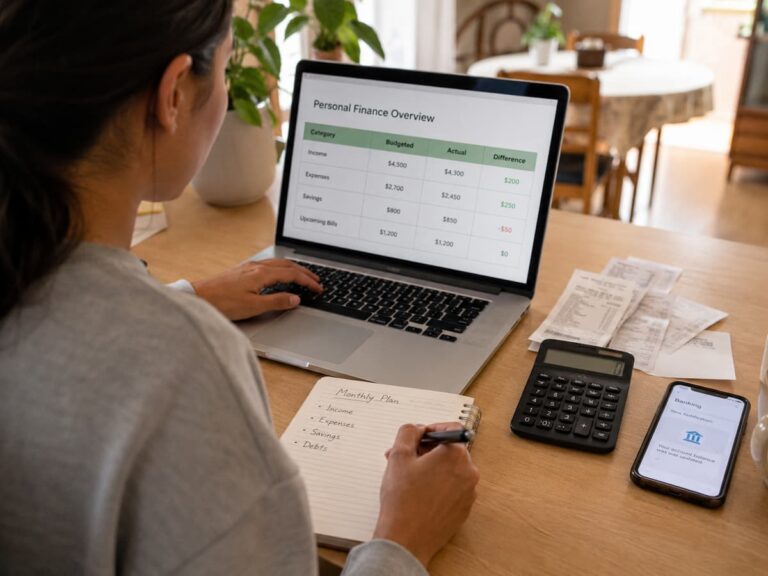

This is especially frustrating when you need to answer a simple question: How much money did I have at a moment in time? Or perhaps you need to obtain a statement for a mortgage application, confirm a questionable transaction, or gather paperwork for a tax return. A sensible system doesn’t aim to make every account appear identical. It delivers a fixed position to each account and a single comprehensive view of your financial history. Once those two levels function together, it’s a whole lot less confusing to deal with many accounts.
Ensure Every Account Has a Clear Purpose
Before sorting through the documents, please write down all of the accounts you currently have. Don’t trust recollection. Log into your banking applications, dig out old statements, and search through your email for financial institutions you may have forgotten about. Now write a basic description for each account that explains what it is actually for. You can have one account for household expenses, one for emergency savings, and one for a side company. The label does not have to be official. It just needs to help you understand why the account is there.
This little practice can help you spot flaws that you often overlook. Maybe you pay fees on an account you hardly use. Maybe there’s money in an old savings account that no longer serves any function. You might even find that you’ve been getting statements for an account you believed was closed. The goal is not to cancel accounts just for the sake of having fewer. It is to know precisely what you have and why you have it. That information makes building the file system a lot easier.
Build the System on Accounts, Not Just Document Types
It is hard to keep things organized in broad categories like “Bank Statements” if you have multiple financial institutions. A statement from one bank might be adjacent to a statement from another, with little indication of whose account the documents refer to. An account-first structure is frequently easier for users with several accounts. You might want to keep distinct files for each institution or account within your primary folder of financial documents.
For example:
- Bank A — Everyday Current Account
- Bank A — Savings Account
- Bank B — Joint Account
- Credit Card — Personal
- Investment Platform
Inside each folder, you can organize documents by year. This means you can immediately narrow a search to one account rather than sorting through every financial statement you have ever downloaded. If you have a large number of accounts, you can take this one step further by using a consistent structure such as Institution → Account → Year. The exact arrangement is less important than using the same logic throughout the system.
A Master Account List Can Save You Hours Later
Once you have several accounts, it is useful to maintain a separate master list. Think of it as an index rather than another collection of financial records. The list might include the institution, account purpose, the last few digits of the account number, and the date you last reviewed it. Avoid storing full account numbers, passwords, or PINs in an ordinary spreadsheet. The purpose of the list is to help you identify accounts, not create a new security risk.
For example, your list might tell you that you have an everyday account ending in 4821, a savings account ending in 7315, and a joint account ending in 9042. If you later download a statement with an unclear file name, the last few digits can help you identify where it belongs. This index is particularly useful when you are preparing tax documents, applying for financial products or reviewing your overall finances. Instead of trying to remember which accounts exist, you have a reliable reference point.
Give Statements a Naming System That Makes Sense
Different banks use different names for their downloaded documents. One might call a file “Statement_2026_03.pdf.” Another may give you something like “eStatement-849372.pdf.” If you leave those names unchanged, it becomes difficult to identify files when they are no longer sitting inside the bank’s website. Rename important documents as soon as you download them. A useful pattern is:
Year-Month — Institution — Account Type — Document
For example:
- 2026-01 — Bank A — Everyday Account — Statement.pdf
- 2026-02 — Bank A — Savings — Statement.pdf
- 2026-03 — Bank B — Joint Account — Statement.pdf
You can adapt the naming pattern to your system. The key is to include enough information that you can understand the file without opening it. Do not feel obliged to rename every document you have ever downloaded in one sitting. Start with your current records and rename older files only when you actually need them. This makes the transition much more manageable.
Separate Regular Statements From Important One-Off Documents
Not every bank document serves the same purpose. A monthly statement is different from a loan agreement, a confirmation of account closure, or a letter explaining a significant transaction. Keeping all of these files together can make important records harder to find. Consider creating a separate area for documents that are likely to matter beyond ordinary monthly account management.
These might include:
- Account opening documents.
- Account closure confirmations.
- Loan or overdraft agreements.
- Important bank correspondence.
- Interest certificates or tax-related documents.
- Records relating to disputed or unusual transactions.
- Documents confirming changes to account ownership.
You do not need to create a separate folder for every type. The point is to distinguish routine statements from records that may need to be retained or retrieved for a specific reason.
Don’t Let Your Banking Apps Become Your Only Record
Modern banking apps make it easy to scroll through transactions, but an app is not necessarily a complete long-term archive. The amount of historical information available can vary between institutions, and the interface may change over time. Download important statements and documents rather than assuming they will always be available in exactly the same format. If you close an account, make sure you have retrieved the records you may reasonably need before access disappears.
This is particularly relevant when you have multiple accounts at different institutions. One bank may provide several years of statements online, while another may offer a shorter history or require you to make a formal request for older documents. Your filing system gives you greater control. You are not relying entirely on a bank’s website to remember where your records are or how long they will remain available.
Create One Place for the Big Picture
There is a difference between storing financial records and understanding your finances. A folder full of statements can be perfectly organized while still telling you very little about your current financial position. That is why people with multiple accounts may benefit from keeping a simple financial overview alongside their document archive.
The overview might show:
- Which accounts you currently have.
- The purpose of each account.
- Which accounts are personal or joint.
- Which accounts are used for regular bills or savings.
- Where important statements are stored.
- When each account was last reviewed.
You do not need to record every transaction in this overview if your banking apps already provide that information. Its job is to give you a high-level map of your financial records. Keep this overview secure. It should never contain passwords, PINs, or complete card details.
Use a “To Review” Folder for Unclear Documents
This is a nice middle ground between flawless organization and total confusion. And when a paper comes in, you can still work and keep track of it. Rule: The folder should be checked often. A temporary folder functions only while it is temporary.
Consider Joint and Shared Accounts Carefully
Recordkeeping can also get more complicated with joint accounts. More than one person can need access to the documents. Your file system should show that these records relate to joint funds. If you share home finance tasks with another individual, agree on where the documents will be kept and who is accountable for keeping them. Don’t put yourself in a position where you are the only one who understands how to access important financial records
Check the permissions for shared folders in the cloud twice. Limit access to those who really need it and take away access when conditions change. It may also be useful to have a safe note of where vital documents are stored. This is useful if one person suddenly becomes unavailable and someone else needs to take on the role of home finance manager.
Handle Closed Accounts Correctly
Households with multiple accounts tend to amass old accounts. Maybe you changed banks, or transferred a savings account, or updated a credit card. The account may be dormant, yet its records count for something. Do not delete all papers merely because an account has been closed. Maintain proper records in accordance with any tax, legal, and financial obligations. This is especially true in the case of an account that was tied to a loan, property purchase, business activity, or other major financial problem.
Once the correct retention term has expired, you should assess whether you still need the records. When you want to dispose of sensitive digital files, be aware that transferring them into a computer’s recycle bin may not be the same as securely deleting them, depending on the device and storage system. If you receive paper statements with important information on them, do not just throw them away in your regular household garbage but employ a secure disposal technique.
Embed Security into the Filing System
Having several bank accounts means multiple sets of financial information. Therefore, you should treat your filing system the same as the accounts themselves. Use secure passwords and multi-factor authentication for online storage and banking accounts, if available. Update and protect your PC and phone with a secure screen lock.
Review who can share financial documents stored in the cloud. A folder of bank statements going back years should not be a public folder or shared over an open link. Back up essential material, but remember, a backup is sensitive data, too. Store it safely and secure access to it. If you use an external drive, consider how you would safeguard the information if the drive were lost or stolen. If you are sharing a bank statement with a third party, assess whether they require the full statement. Unnecessary detail may be removed as appropriate, where only particular information is required. Before you make a redacted copy, keep an original copy in a safe place.
Develop a Routine That Fits Your Banking Habits
The best filing system is the one that fits naturally into your current routine. If you check your accounts only once a week, you can use that time to download any new statements or crucial documents. If you are sending statements monthly, a monthly financial admin session may be sufficient. It’s not that you are going to spend hours keeping records. It’s to keep paperwork from piling up in random places.
A good habit to get into is to spend a few minutes each month reviewing four things: new statements, odd papers, the temporary folder “To Review,” and your backup. There is no need to scrutinize each and every transaction unless you have a reason to do so. Review more thoroughly once or twice each year. Review your list of accounts for accuracy, delete any obvious duplicates, and keep critical documents from closed accounts in order.
What If You Have Too Many Accounts to Track Easily?
If you’ve gotten to the point where you can’t recall why you have particular accounts, the problem may be more than your filing system. Organization can allow you to comprehend your accounting, but it won’t inevitably make an unduly complicated financial setup efficient. Look for accounts that do the same thing. Maybe you have more than one savings account but don’t utilize some of them much. Perhaps there is an old current account still open because you have never gotten around to shutting it.
Don’t rush to terminate accounts without contemplating the potential repercussions. Then check for outstanding payments, direct debits, subscriptions, minimum balance requirements, interest consequences, and any other applicable conditions. Clarity should be the goal, not a number of accounts. Some people do find it useful to have some money put away for different things. For some people, too many accounts might make their finances more difficult to manage.
A Simple Example of the Multi-Account Filing System
Take a person with 4 accounts: A day-to-day current account, a savings account, a joint account for the home, and a credit card. They don’t have all the statements in one folder but instead have one main one labeled “Financial Records.” They make four folders of accounts in it. Each folder is subfoldered by year. Each statement is named the same way. There’s also a separate “Important Documents” folder, which holds loan agreements, account closure confirmations, and other items that don’t fit neatly into monthly statements.
They also keep a simple index of accounts that indicates the institution, the purpose of each account, and the last few digits of each account. A secure backup is a second copy of vital records. When a new statement arrives, it is downloaded and renamed and put in the proper account folder. If there’s no time to organize right away, it goes into “To Review” and is dealt with at the next monthly financial admin session. There’s nothing complicated about this system. But the power is in the regularity. The person understands where each account is, how the files are labeled, and what to do when a new document arrives.
The Real Aim Is Financial Transparency
Managing records across several bank accounts is more than a folder housekeeping exercise. It might assist you in getting a picture of the architecture of your financial life. When each account has a purpose and every critical document has a home, you spend less time searching and more time deciding. It is easier for you to provide statements when a lender asks for them, examine a transaction, or get financial records ready for tax purposes.
Gaps are also simpler to see. You can discover that one account has no saved recent statements, an old account is still active, or a critical document is only inside an email inbox. A well-run business does not need to have impeccable records from the beginning of time. You need a system that you know and can keep going forward.
Conclusion
Multiple bank accounts don’t have to equal multiple sources of financial confusion. Once you’ve given each account a personality and a fixed place to store its records, the paperwork becomes much easier to handle. First, make a full list of accounts. Next, make folders for the accounts you do use, label files in a way that’s easy to recognize, and keep regular statements distinct from documents that need particular attention. Have a basic summary to see the overall picture without opening dozens of statements.
Security needs to stay part of the process. Protect your accounts and devices, back up your data, and be careful when sharing financial documents with anyone. The most elaborate system is not always the best one. It is the one that allows you to answer basic questions quickly: Which accounts do I have? Where are the records?? What documents are valid? When did I last review all of this? If your filing system can answer those queries without a lengthy search, it is doing its job.
FAQs
It is advisable not to remove them immediately upon account closure. The proper term for retention will vary depending on the document and your personal, fiscal, and legal situations. Keep critical records as required by relevant rules, especially when a previous account was associated with significant financial activity.
2. How to keep track of all my bank accounts?
A brief list of master accounts can be helpful. Write down the institution, the basic purpose of the account, and maybe the final few numbers of the account number. Avoid keeping passwords, PINs, or full account details in a standard list. From time to time, review the list to ensure that it accurately reflects your accounts.
3. Do I need to keep my bank statements forever?
Not really, no. Financial records should normally be kept in accordance with applicable tax, regulatory, and practical requirements. Some records must be retained for a defined length of time; some have long-term worth. Check the official guidance that pertains to your situation before deleting older records.
4. What if I can’t locate my old bank statements online?
Call the bank’s official customer care number and ask about retrieving your old statements. If you require older records for a crucial financial or legal purpose, ask for them as far in advance as you can, rather than waiting until the last minute.
5. How often should I file my financial records?
Monthly review is fine with a lot of individuals. Use it to process new statements and documents and to clear up the temporary filing folder. A more extensive examination once or twice a year will help you uncover duplicate files, review old accounts, and ensure your backup system is working.