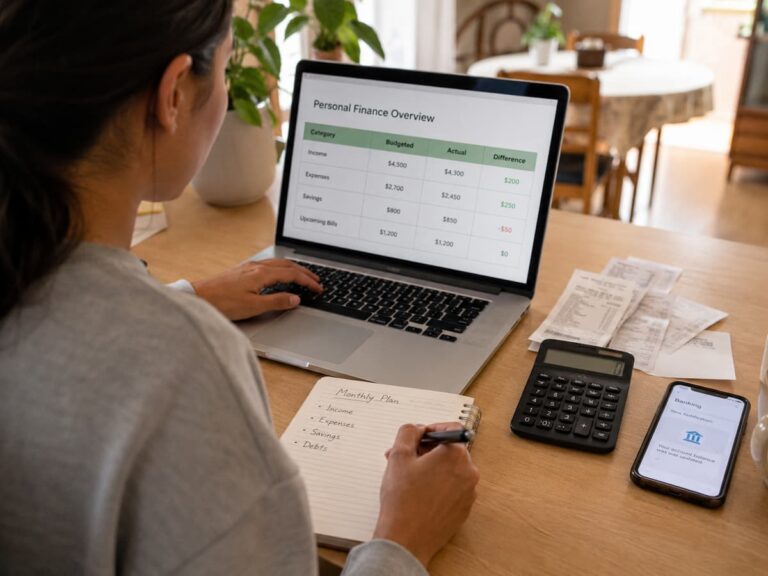

Living together often means having to make more financial decisions than you expect. Rent or mortgage, energy costs, groceries, internet, insurance, repairs, subscriptions, and daily expenses can quickly become chaotic if no one clearly knows what their responsibilities are. Even if both partners pay the same amount, they may disagree about whether they have paid a bill. The problem often lies not in the amount but in the lack of a clear financial management system.
Managing family finances does not mean merging all bank accounts or handling money in exactly the same way. A better approach is for both partners to agree on which expenses are shared, how to calculate the share, assign responsibility for regular payments, and set up a simple bookkeeping system. This guide introduces a number of practical methods to help you share financial responsibilities within the family, address income disparities, manage irregular expenses, and prevent small misunderstandings from escalating into larger financial problems.
Start With the Expenses You Actually Share
The first step is to avoid viewing family finances as a messy jumble of expenses. Instead, categorize expenses based on who benefits from them. Some expenses are naturally shared by both partners, while others are individual expenses. Rent, mortgage, energy costs, internet costs, and jointly purchased groceries, for example, are common household expenses. However, individual phone plans, hobbies, clothing purchases, or individual subscriptions do not belong in the joint budget.
This distinction is crucial because fairness is difficult to guarantee when partners view every expense as a shared responsibility. Imagine that one partner uses a streaming service daily, while the other rarely watches it; in that case, automatically sharing the costs might be unreasonable. On the other hand, if both partners regularly use the family internet, it is more appropriate to consider this a shared expense.
| Expense Type | Usually Shared? | Question to Ask |
|---|---|---|
| Rent or mortgage | Usually | Who lives in the home, and how should the housing cost be divided? |
| Utilities | Usually | Do both people use the service? |
| Groceries | Often | Are the groceries mainly for shared meals? |
| Personal phone | Usually not | Does only one person use the plan? |
| Personal hobbies | No | Who receives the main benefit? |
| Home repairs | Usually | Is the repair necessary for the shared home? |
Before discussing percentages or payment methods, make a complete list of recurring and occasional household costs. This helps both people see the same picture and keeps them from forgetting important expenses.
Choose a System That Fits Your Household
There is no single correct way for two people to manage shared finances. Some households combine most of their money. Others keep their accounts completely separate and split expenses. Many use a middle approach in which each person keeps personal accounts but contributes to shared household costs through a joint account or agreed payment system.
The best arrangement is one that is easy to understand and maintain. A complicated system may look fair on paper but become frustrating after several months. If every grocery receipt requires a detailed calculation, someone will eventually stop tracking it. A simpler system with clear rules is often more sustainable.
| System | How It Works | Potential Advantage | Possible Challenge |
|---|---|---|---|
| Equal split | Both people contribute the same amount. | Simple to calculate | May feel difficult with unequal incomes |
| Income-based split | Contributions reflect each person’s income | Can better match ability to contribute | Requires honest income discussions |
| Shared account | Both contribute money to a household account. | Shared bills are straightforward to pay. | Requires clear account rules |
| Separate accounts | Each person pays assigned expenses. | Maintains financial independence | Uneven bills can be overlooked. |
| Hybrid system | Shared expenses are combined, while personal money stays separate. | Balances cooperation and independence | Needs clear boundaries |
A hybrid system is often practical because it separates household responsibilities from personal spending. The important point is not which system sounds best. It is whether both people understand the rules and agree that the arrangement is workable.
Decide What a Fair Contribution Looks Like
Dividing equally does not necessarily mean fair, but it is certainly simpler to split all expenses 50/50. If one partner earns significantly more, sharing the same amount can create an unequal burden on their budgets. Some families choose to divide expenses based on income. Suppose both partners earn €5,000 per month, one €3,000 and the other €2,000. Then the first pays 60% of the household budget and the second 40%. Of the €2,000 they share, they pay €1,200 and €800, respectively.
This is just an example, not a strict rule. Some partners or housemates prefer an equal division, while others take into account factors such as income, employment situation, family responsibilities, or property. It is crucial to determine how expenses are divided before conflicts arise. When discussing a fair division, focus on the family’s overall situation, not just on individual bills. Consider whether the cost allocation should be used to pay current bills or for future family expenses. A cost allocation system that pays all bills but does not cover repair or replacement costs may seem balanced at first, but it will show its flaws when an expensive breakdown occurs.
Assign Responsibility for Recurring Bills
One of the easiest ways to create confusion is to say that both people are “responsible” for every bill without deciding who actually makes each payment. Shared responsibility should still have clear ownership. If the electricity bill is due on the 15th, one person should know they are responsible for checking and paying it.
This does not necessarily mean that the person pays the entire cost out of their own money. The household can have an agreed-upon contribution system. The important distinction is between financial responsibility and payment administration.
| Bill | Payment Owner | Funding Method | Review Frequency |
|---|---|---|---|
| Rent | Person A | Shared household funds | Monthly |
| Electricity | Person B | Shared household funds | Monthly |
| Internet | Person A | Shared household funds | Monthly |
| Home insurance | Person B | Agreed household contribution | Annually |
Set reminders for due dates and keep confirmation records. If automatic payments are used, still review statements occasionally. Automation reduces the chance of forgetting a bill, but it does not guarantee that the amount is correct.
Plan for Irregular Household Expenses
Monthly bills are only part of the financial picture. Household costs often include expenses that appear every few months or once a year. Examples include appliance repairs, vehicle maintenance, insurance renewals, property taxes, school-related costs, annual subscriptions, furniture replacement, and seasonal utility increases. These expenses cause problems when households build their budgets only around predictable monthly bills. Instead of waiting until an expensive repair arrives, estimate likely irregular costs and set aside money gradually.
For example, if you expect $1,200 of household maintenance expenses during a year, setting aside about $100 per month creates a reserve. The actual amount will vary, and not every year will require the same spending, but the principle is useful: predictable irregular expenses should be planned rather than treated as surprises.
Handle Groceries and Everyday Spending
Groceries can be surprisingly difficult to divide because shopping habits vary. One person may buy mostly shared food, while the other adds personal snacks, specialty products, or household items. A rigid receipt-by-receipt split can become more work than the expense is worth.
Instead, decide what your household considers a shared grocery purchase. If both people eat most of the same meals, a shared grocery budget may be easiest. If their diets are completely unique, each person could pay for personal items while splitting common household staples. The same principle applies to small household purchases such as cleaning supplies, light bulbs, kitchen items, and toiletries. Decide whether these belong to a common household category instead of negotiating every small receipt.
Make small purchases predictable.
A monthly household spending allowance can reduce repeated conversations. If the household normally spends $500 on groceries and basic supplies, that amount can become a planned budget. If spending regularly exceeds it, review what is driving the increase rather than arguing about individual purchases. Do not make the system so strict that people avoid buying necessary items because they are afraid of exceeding the budget. A household budget is a planning tool, not a punishment system.
Keep Personal and Shared Money Clear
Sharing financial responsibilities does not automatically mean every account must become joint. Two people may want to maintain personal spending money while contributing to common expenses. This can provide a clear boundary between household obligations and individual choices. For example, a household might use a shared account for rent, utilities, groceries, and agreed home expenses. Each person could then maintain a separate account for clothing, hobbies, gifts, entertainment, or other personal purchases. The exact categories should be agreed upon rather than assumed.
Clear boundaries are especially useful when one person makes a purchase that the other does not consider a household expense. Instead of asking whether the purchase was “allowed,” the system answers a simpler question: which category does it belong to? Financial privacy also matters. Both people should understand what they have agreed to share and what remains personal. Transparency about shared obligations does not necessarily require unrestricted access to every personal transaction.
Create a Simple Tracking System
You do not need expensive financial software to track household responsibilities. A spreadsheet, budgeting application, or shared document can be enough. The important thing is that both people can understand the system without needing a private explanation from the person who created it.
A basic tracker might contain the expense name, expected amount, due date, payment owner, and status. For variable bills, record the actual amount after payment. For annual expenses, record the expected renewal date and monthly amount being set aside.
| Expense | Due Date | Expected Cost | Responsible Person | Status |
|---|---|---|---|---|
| Rent | 1st | $1,400 | Person A | Scheduled |
| Electricity | 15th | $120 | Person B | Pending |
| Internet | 20th | $60 | Person A | Paid |
Keep the tracking process short. If updating it takes 30 minutes every day, the system is too complicated for ordinary household use. A quick weekly or monthly review is often enough for routine expenses.
When Two People Earn Different Amounts
Unequal income does not automatically mean that the higher earner should pay for everything. It does mean the household may need to think more carefully about how shared costs affect each person’s available money.
Start with the combined household needs. Then compare possible contribution methods. An equal split might work if both incomes are similar. An income-based split may be more practical when there is a significant difference. Some households also use a mixed approach, such as dividing essential costs according to income while sharing certain discretionary expenses equally.
Non-financial contributions are important but should not be assigned an arbitrary dollar value. One person may handle more cooking, cleaning, childcare, scheduling, or household administration. These responsibilities affect the household even when they do not appear on a bank statement. The goal is not to create a perfect mathematical formula. The goal is to create an arrangement that both people understand and consider reasonable.
Prevent Common Household Money Conflicts
Many household money arguments begin with assumptions. One person assumes the other will pay a bill. Someone else assumes an expense was included in the shared budget. A subscription renews without either person remembering it. You can often prevent these problems by making small decisions in advance. Agree on a spending threshold that requires discussion. For example, the household might decide to discuss purchases above a certain amount before using shared funds. This does not need to apply to emergencies or ordinary bills. It simply creates a boundary for larger discretionary expenses.
It also helps to discuss what happens when a bill is higher than expected. If the electricity bill doubles during a particularly hot month, neither person should have to guess whether the increase is acceptable. The household can review the reason and adjust another category if necessary. Discuss the system when everyone is calm. Do not wait until a missed payment or unexpected expense has already created frustration. Another useful rule is to review the arrangement without turning the meeting into a blame session. Ask what is working, what is confusing, and what needs to change.
Review the Arrangement Regularly
A household financial system that worked six months ago may not work today. Income can change, rent can increase, utility costs can rise, subscriptions can accumulate, and new responsibilities can appear. A regular review gives both people a chance to adjust the system before problems grow.
A monthly review does not need to be a formal meeting. Set aside 20 or 30 minutes to look at upcoming bills, recent spending, savings for irregular expenses, and any changes in income or household needs.
Questions worth asking
- Are all shared bills assigned to someone?
- Are contributions still affordable for both people?
- Did any recurring bill increase?
- Are there subscriptions that are no longer useful?
- Are irregular household expenses being funded?
- Did one person take on much more administrative work?
- Is anything about the current system causing repeated confusion?
Do not change the system simply because one month was unusual. Look for patterns. A single high electricity bill may be temporary, while several consecutive increases could indicate that the budget needs to be updated.
A Practical Household Finance Checklist
Use this checklist when setting up or reviewing a shared household financial system:
- List every regular household expense.
- Separate shared expenses from personal spending.
- Record annual and irregular expenses.
- Choose how each shared expense will be divided.
- Assign one person to monitor each recurring bill.
- Agree on how grocery and household purchases will be handled.
- Decide whether a shared account is useful.
- Set rules for larger discretionary purchases.
- Create a simple method for tracking payments.
- Set aside money for predictable irregular costs.
- Agree on what happens when income changes.
- Review the arrangement regularly.
The checklist is not meant to create unnecessary bureaucracy. It is simply a way to turn vague expectations into clear responsibilities. The fewer things people have to guess about, the fewer opportunities there are for misunderstandings.
Conclusion
Effectively sharing financial responsibilities between two people does not require a complicated budgeting system. It starts with something simple: determining what belongs to the family, who is responsible for which tasks, and how joint expenses are divided. A practical system can build upon these principles and include a list of joint expenses, clear bill allocation, methods for managing groceries, contingency plans for irregular expenses, and a simple tool for tracking expenses. Separating personal and joint expenses, where necessary, also helps better understand each other’s responsibilities.
The most important thing is communication. The existing system must be re-evaluated whenever income, expenses, or family responsibilities change. If both partners understand their respective responsibilities, there will be no missed payments or arguments over daily expenses. There is no perfect solution for every family. Practical implementation is more important than ideal plans on paper. Start by creating a clear list of expenses, agree on how expenses are divided, keep records concise and clear, and re-evaluate the arrangements when circumstances change. A well-organized family budget should make managing financial responsibilities easier, not harder.
FAQs
1. Do two cohabitants need to open a joint bank account?
Not necessarily. Joint accounts can simplify managing shared accounts, but they are not a requirement for an effective family budget. Both partners can open their account and divide expenses according to a mutually agreed method. A hybrid approach is also possible, for example, a joint account for household expenses and a separate account for personal expenses. The most important thing is that both partners are clear about their contributions, which expenses are shared, and who is responsible for payments.
2. Is it always fair to divide family accounts 50/50?
Not necessarily. Although 50/50 is simple, its fairness depends on the specific circumstances of the family. If both partners have a similar income and use shared resources in a similar way, an equal division of the account might be more appropriate. If there is a significant income gap, a division based on income ratios can result in a more balanced financial burden. Some families combine multiple methods. The best arrangement is one that both partners understand and agree upon, rather than randomly choosing a formula.
3. How should couples manage groceries?
There is no single definitive answer to this question, as everyone’s shopping habits differ. If both partners consume approximately the same types of food, drawing up a joint grocery budget is perhaps the simplest approach. If someone regularly buys expensive personal items, they can choose to pay for these individually while sharing basic food costs. It is important to clarify which food items fall under the category of joint purchases before disagreements arise. Reviewing food expenses monthly also helps determine if adjustments to the family budget are necessary.
4. Should personal expenses be discussed in a cohabiting household?
If everyone uses their money, personal expenses do not necessarily need to be approved jointly. However, important personal financial decisions can have consequences for the family, especially if they affect someone’s ability to pay shared expenses. Therefore, families must distinguish between financial privacy and shared financial responsibility. Both parties need sufficient information to plan household expenses, while personal expenses can remain personal as long as they do not affect the agreed responsibilities.
5. What if someone forgets to pay a bill?
First, determine whether the problem stems from unclear responsibilities or simply an unintentional mistake. Using shared calendars, automatic payments, or reminders can prevent recurrence. If fines or other costs arise, these must be discussed in accordance with existing family agreements. Avoid turning a single late payment into a full-blown accusation regarding someone’s financial habits. A more effective approach is to improve existing systems to reduce the likelihood of such errors recurring.